
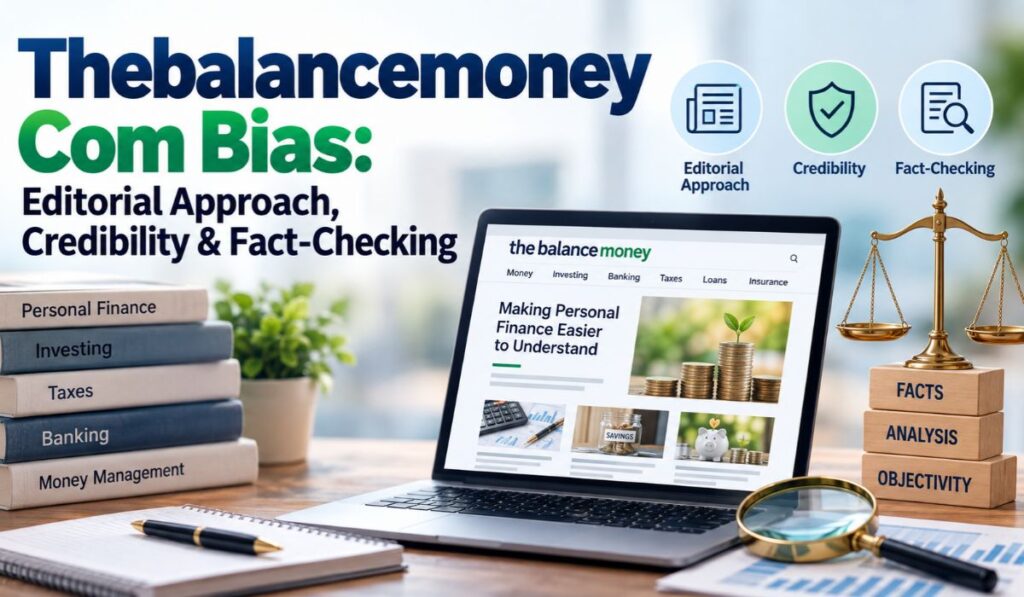

The purpose of people searching thebalancemoney com bias is whether The Balance covers financial and economic issues objectively or whether its coverage is influenced by a particular political or commercial ideology. Such a question is vital because financial facts can drive how people read (or misread!) investing, taxes, banking, loans insurance and wider economic issues.
The Balance is a personal finance and financial education website owned by Dotdash that operates as a People Inc. brand. The publication is underpinned by its own About Us page which states it helps break down the complexities of personal finance to make it easier and provide news, guides, and product reviews. The company states that its editorial content is created by qualified writers and editors and is fact-checked and graded.
When looking at thebalancemoney com bias, we should look at three different things: political bias, commercial influence and factual accuracy. Importantly, a website can have an editorial point of view without publishing outright misinformation (i.e., fake news), and affiliate partnerships might create possible commercial interests but don’t automatically dictate the angle taken by any one article.
Quick Facts About The Balance
| Factor | Information |
| Website | The Balance |
| Main focus | Personal finance, investing, banking, taxes, money management and financial education |
| Parent company | People Inc. |
| Established | 2016 |
| Content approach | Financial guides, news, reviews and educational resources |
| Editorial review | Staff editing and fact-checking |
| Financial Review Board | Professional financial experts |
| Primary sources | Government data, studies, institutions, experts and other authoritative sources |
| Commercial relationships | Affiliate and advertising relationships are disclosed |
| External bias assessment | Media Bias/Fact Check currently rates it Least Biased |
| External factual assessment | Media Bias/Fact Check currently rates factual reporting High |
This is particularly useful while researching thebalancemoney com bias. Media Bias/Fact Check rates The Balance as Least Biased and mostly factual in original content. Praise for this partners with its assessment of relatively limited loaded language and balanced treatment of financial issues.
What Does Thebalancemoney Com Bias Mean?
Thebalancemoney com bias – thebalancemoney com bias is a term that can refer to multiple types of bias. The most obvious, and non-nefarious if not entirely honorable, interpretation is political bias.
Political bias is whether an outlet leans liberal or conservative, towards one political ideology or the other. Financial bias includes the presentation of investments, banks, credit products, taxes, government policies or economic decisions made by a financial outlet. Commercial bias addresses the question of whether editorial recommendations have been influenced by advertisers, sponsors or affiliate relationships.
These should not inherently be regarded as the same type of category.
According to The Balance, advertising and its editorial content are seen independently from one another, with advertising kept away from the editorial product. It also states that sponsored content is identified as such, clearly and appropriately.
So, while we should analyze thebalancemoney com bias with the stated policies of a publication in comparison to its fact checks, it can’t really be done on articles alone and instead needs information outside of individual articles.
Is The Balance Politically Biased?
The available external evidence does not characterize The Balance as closely associated with either political side.
Currently Media Bias/Fact Check describes The Balance as a “Least Biased” outlet, and notes that they employ little loaded language throughout their articles and cover financial news in an roughly equal manner. Overall, the organization has a High factual reporting ratingand says that in its examination it did not find any failed fact checks defined as part of the organization’s assessment.
But it is important to note that a bias rating is not an indication that every article will be entirely fair. Rather, they are methodologies with no guarantees. Even when the overall publication is evaluated as neutral, a single article may highlight specific facts, frame in a particular way or ignore one side of the account.
It is this difference that plays an important role when looking for thebalancemoney com bias.
Material by The Balance that pertains to government policy and the law of economics is also published here. This is of course a natural subject for competing political narratives. For this reason, readers should scrutinize the sourcing and phrasing of particular articles, especially when a story involves divisive laws or government actions.
The Balance’s Editorial Guidelines
To learn more about how we do what we do, check out The Balance’s editorial policies. The publication says its editors and writers check facts, investigate claims, and verify information used in articles. Articles are reviewed by staff editors and fact-checkers who judge accuracy, relevance and timeliness.
It adds that the publication expects writers to use primary sources. These may comprise the rest government data, academic institutions, professional bodies for studies, interviews and original journalism.
This editorial process matters to the balancemoney com bias because it allows readers to trace the source of claims.
The Balance has its own corrections policy. As the company states in its own guidelines, it will verify correctness and name corrections clearly.
The Financial Review Board
A second major part in evaluating thebalancemoney com bias is learning about The Balance’s Financial Review Board.
It says its Financial Review Board consists of experts in investing, taxes, debt, financial planning and economics. As per The Balance, an appropriate board member receives written articles for review, and the reviewer reviews them for accuracy and relevance before returning it to editorial staff.
Some articles have this review indicator, which means a Financial Review Board member reviewed the content.
This is primarily a cashing out process aimed at improving financial accuracy rather than determining political neutrality per se. Thus, do not be confused by financial expert review and an independent audit for political-bias.
Does Advertising Influence The Balance?
A second major part in evaluating thebalancemoney com bias is learning about The Balance’s Financial Review Board.
It says its Financial Review Board consists of experts in investing, taxes, debt, financial planning and economics. As per The Balance, an appropriate board member receives written articles for review, and the reviewer reviews them for accuracy and relevance before returning it to editorial staff.
Some articles have this review indicator, which means a Financial Review Board member reviewed the content.
This is primarily a cashing out process aimed at improving financial accuracy rather than determining political neutrality per se. Thus, do not be confused by financial expert review and an independent audit for political-bias.
How Reliable Is The Balance?
It divorces the questions of reliability and political neutrality.
The Balance is currently rated High for factual-reporting by Media Bias/Fact Check, which describes its sourcing as Strong. Its new assessment also reports no failed fact checks.
The Balance itself has a display which states that “What is fact-checked – factual statements are verified by editors and researchers, adequate sources for hotly contested claims (e.g. emotional rhetoric or discounting others) are needed.”.
Its massive editorial is filled with writers, editors, fact-checkers, copy editors, financial experts and review-board members.
But news consumers should exercise the routine media-literacy muscles. In the financial world information can age quickly, as interest rates, tax rules, regulations, market conditions and product terms change over time.
How to Check an Article for Bias Yourself
If readers wish to examine a single article rather than search for thebalancemoney com bias, several questions can be used.
Step one: Who is the author, and who reviewed it? The author must possess some professional credentials for an individual to trust him or her in a specific area.
Second, look at the sources. Useful evidence can be found in government agencies, academic studies, regulatory organizations and official company documents and primary data.
Third, separate facts from commentary. There is a difference between facts about a tax change and arguments about why the change might be good or bad.
Fourth, examine the language. Persuasive wording might seem highly emotional or exaggerated (for example, some descriptions are less obviously editorially framed than other simple ones).
In the end, facts should be compared against independent sources. This is especially relevant whenever the article talks about political legislation, economic policy, investment products, or politically-unpopular financial subjects.
Why Bias Can Be Difficult to Measure
No one agreed upon number can adequately quantify media bias.
Different methodologies are employed by organizations that assess media outlets. For instance, AllSides, in describing its ratings, notes that the content is based on written online materials and indicates that multiple approaches are used with extensive input provided by Americans from across the political spectrum. It also stresses that its ratings are subject to change with additional information.
In other words, a bias label should be thought of as an outcome of a process not as an unqualified assessment made on each sentence published by the organization.
This principle is the same again for a research on thebalancemoney com bias.
The Balance Compared With Other Financial Sources
The Balance is an online personal finance education and information site. It focuses on the topics of banking, credit, investing, taxes, retirement planning and insurance.
Readers may want to consult primary sources, as well as financial publications for significant financial decisions. The context can be gleaned from the State administration and its institutions, regulators, institutions in the financial sector, academic research and official product documents.
When the information is of a nature that it will affect a person’s taxes, investments, debt obligations, insurance coverage or legal duties this is especially important.
The Balance itself acknowledges that it offers no personalized legal, tax, accounting, or investment services in their disclaimer and suggests talking to qualified professionals regarding personal finance decisions.
Thebalancemoney Com Bias: Overall Assessment
The bias of thebalancemoney com is best considered by external ratings and The Balance’s own editorial policies.
In fact, The Balance is currently in the Least Biased category on Media Bias/Fact Check and has a factual reporting rating of High. According to The Balance: the site uses fact-checking, editorial review, primary sources, financial experts and a Financial Review Board.
Simultaneously, no editorial publication needs to be presumed completely unbiased in each and every article. These stories can vary in various ways, including how they are framed, the choice of sources, and their topic emphasis and presentation. Readers can thus evaluate whether the article, its sources, its author, its review status and its advertising or affiliate disclosures matter.
With financial information that has serious personal implications, it is still important to fact check this information against primary sources and attorneys or accountants qualified to comment.
Frequently Asked Questions
1. What is thebalancemoney com bias?
Thebalancemoney com bias took searches about The Balancehaving political, financial, editorial or commercial bias. External Assessment Current Rating from Media Bias/Fact Check Least Biased
2. Is The Balance considered politically biased?
The Balance has not been clearly tagged as left or right political side based on the best available information at this time. Media Bias/Fact Check rates its reporting as moderately balanced, but individual articles should still be carefully assessed.
3. Is The Balance reliable for financial information?
The Balance is High on the Media Bias / Fact Check scale for factual reporting. The Balance also refers to a blueprint that has editors, fact-checkers, main sources and financial professionals in the editorial process.
4. Does The Balance use affiliate links?
Yes. According to The Balance, it may receive compensation from partner links and affiliate marketing programs. The disclosure also states that any compensation of a similar nature does not impact product recommendations or placement in the review.
5. Does The Balance fact-check its articles?
Yes. The Balance claims that articles are vetted by staff editors and fact-checkers, and information is assessed for factual accuracy, relevance, and timeliness.
6. Should readers trust The Balance for major financial decisions?
The Balance may be a good source of information, but any big financial decisions should not hinge on just one site. The Balance itself, in fact, notes that it does not give personalized financial, legal, tax or accounting advice and suggests qualified advisers should be consulted where appropriate.
Final Thoughts
Thebalancemoney com bias is not just a matter of slapping a political label on a financial site, according to research. The Balance: Personal finance education, financial news and views, product reviews; editorial policies focused on sourcing, fact checking, corrections, financial review and the wall between advertising and editorial.
The Balance is currently rated Least Biased by an independent Media Bias/Fact Check assessment and also rates High for factual reporting.
Nevertheless, readers should assess each article individually, looking at sources, facts and phrasing historic date as well as authors and disclosures. Especially high-impact financial decisions, primary sources and professional advice can act as further impetuses against Misinformation by filtering out outdated or incomplete information.
For more cricket-related updates, statistics, match scorecards, player records, and the latest cricket information, readers can also explore Cricket Status. The platform covers a wide range of cricket topics, including match reports, team records, player profiles, and tournament updates.